

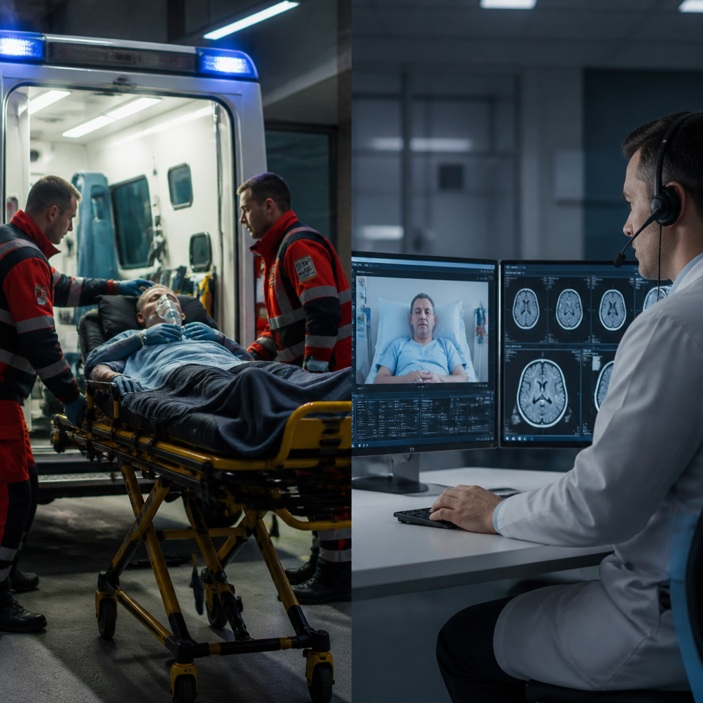
When stroke symptoms appear, every minute counts. The difference between full recovery and permanent disability often depends on how quickly specialized care reaches the patient. Yet many regions face a critical shortage of neurologists, particularly during overnight hours and in areas far from major medical centers. Remote stroke consultation technology has emerged as a practical solution, connecting emergency departments with stroke specialists through secure video links and real-time brain imaging review.
This approach addresses a fundamental problem in acute care: stroke treatment requires immediate decisions about clot-busting medications and mechanical thrombectomy, but these decisions demand expertise that not every facility can staff around the clock. The technology works by transmitting CT scans and patient assessments to neurologists who can evaluate cases from distant locations, often within minutes of a patient’s arrival at a local hospital.
Table of Contents
The Critical Window for Stroke Intervention
Ischemic strokes, which account for roughly 87 percent of all strokes, occur when blood flow to part of the brain becomes blocked. The standard treatment involves tissue plasminogen activator (tPA), a medication that dissolves blood clots when administered within 4.5 hours of symptom onset. For large vessel occlusions, mechanical thrombectomy can be effective up to 24 hours after onset in selected patients, though earlier intervention consistently produces better outcomes.
The challenge lies in accurate diagnosis and rapid decision-making. Hemorrhagic strokes, which involve bleeding in the brain, present with similar symptoms but require entirely different treatment. Administering tPA to a hemorrhagic stroke patient can be fatal. This makes immediate imaging and expert interpretation essential, yet many community hospitals lack on-site neurologists trained in acute stroke care, particularly outside regular business hours.
How Remote Consultation Works in Practice
When a patient with suspected stroke arrives at a participating emergency department, the local team performs initial assessments and brain imaging. These images are transmitted digitally to a stroke neurologist at a hub facility, often a comprehensive stroke center. Through high-definition videoconferencing equipment, the remote neurologist conducts a real-time neurological examination, observing the patient’s facial symmetry, arm strength, speech patterns, and other critical indicators.
The neurologist reviews the imaging studies on their own workstation, looking for signs of bleeding, the extent of damaged tissue, and whether the patient meets criteria for thrombolytic therapy or transfer for advanced procedures. This consultation typically takes 15 to 30 minutes from connection to treatment recommendation. For facilities in the UAE and other regions with geographic challenges, services like telestroke uae programs have expanded access to subspecialty expertise, allowing smaller hospitals to treat stroke patients who would previously have required immediate transfer.
Beyond Emergency Treatment: Long-Term Recovery Considerations
Surviving the acute phase of stroke is only the beginning. Recovery involves physical therapy, speech therapy, occupational therapy, and often significant lifestyle modifications to prevent recurrence. Stroke survivors face elevated risk for depression, cognitive changes, and secondary health complications. Many also need ongoing medical management to address underlying conditions such as atrial fibrillation, hypertension, or diabetes.
Hormonal factors can influence both stroke risk and recovery, particularly in women. Estrogen levels affect vascular health, blood clotting mechanisms, and inflammatory responses. Women face unique risk periods during pregnancy, in the postpartum phase, and during menopause transitions. Understanding these connections helps patients and clinicians develop more targeted prevention strategies, and addressing hormonal balance through lifestyle modifications can play a role in reducing vascular risk factors over time.
The Role of Advanced Imaging in Stroke Care
Modern stroke diagnosis relies heavily on imaging technology. Non-contrast CT scans remain the first-line tool because they rapidly distinguish between ischemic and hemorrhagic stroke. CT angiography provides detailed visualization of blood vessels, helping identify blockages suitable for mechanical removal. MRI offers superior sensitivity for detecting early ischemic changes and small strokes that CT might miss.
Perfusion imaging, available through both CT and MRI, shows which brain tissue is already dead and which remains salvageable but at risk. This information guides decisions about extended treatment windows, particularly for patients who wake up with stroke symptoms or cannot provide an accurate symptom onset time. The same imaging technologies used in stroke care often serve multiple purposes within healthcare systems, supporting diagnosis of conditions like breast cancer through different protocols and applications of similar equipment.
Identifying and Managing Stroke Risk Factors
Prevention remains more effective than treatment. High blood pressure stands as the single most important modifiable risk factor, increasing stroke risk by two to four times when uncontrolled. Atrial fibrillation, an irregular heart rhythm affecting millions worldwide, raises stroke risk fivefold by allowing blood clots to form in the heart chambers. Diabetes, high cholesterol, smoking, obesity, and physical inactivity all contribute measurably to stroke risk.
Regular screening plays a crucial role in identifying these risk factors before they cause damage. Blood pressure checks, lipid panels, blood glucose testing, and electrocardiograms provide actionable information. For patients with known risk factors, medications such as antiplatelet agents, anticoagulants, statins, and antihypertensives significantly reduce stroke incidence when used appropriately.
Rehabilitation and Quality of Life After Stroke
Neuroplasticity, the brain’s ability to reorganize and form new neural connections, underlies stroke recovery. Intensive, repetitive practice of impaired functions drives this reorganization. Physical therapists work on mobility, balance, and coordination. Occupational therapists address activities of daily living, from dressing to meal preparation. Speech-language pathologists treat communication disorders and swallowing difficulties.
Recovery trajectories vary enormously. Some patients regain most function within weeks, while others face permanent disabilities. Early intervention produces the best outcomes, but improvements can continue for months or even years with sustained effort. Constraint-induced movement therapy, task-specific training, and newer approaches involving robotics and virtual reality show promise in augmenting traditional rehabilitation methods.
Building Resilient Stroke Care Systems
Effective stroke care requires coordination across multiple levels. Public awareness campaigns teach recognition of warning signs through tools like FAST (Face drooping, Arm weakness, Speech difficulty, Time to call emergency services). Emergency medical services follow protocols to transport suspected stroke patients to appropriate facilities. Hospitals maintain certification standards that ensure staff training, equipment availability, and rapid response procedures.
Remote consultation technology extends the reach of specialized expertise but does not replace comprehensive stroke centers for the most complex cases. Patients with large vessel occlusions still benefit from direct admission to facilities offering mechanical thrombectomy. The optimal system combines hub-and-spoke models, where smaller hospitals stabilize and treat appropriate cases while transferring others to comprehensive centers for advanced interventions.
As healthcare systems continue adapting to technological capabilities and changing demographics, stroke care illustrates both the potential and limitations of remote medicine. The technology enables faster treatment decisions and broader access to expertise, but outcomes still depend fundamentally on rapid recognition, efficient systems, and comprehensive rehabilitation support. For patients and families, understanding these elements helps them navigate an event that remains one of the leading causes of death and disability worldwide.