

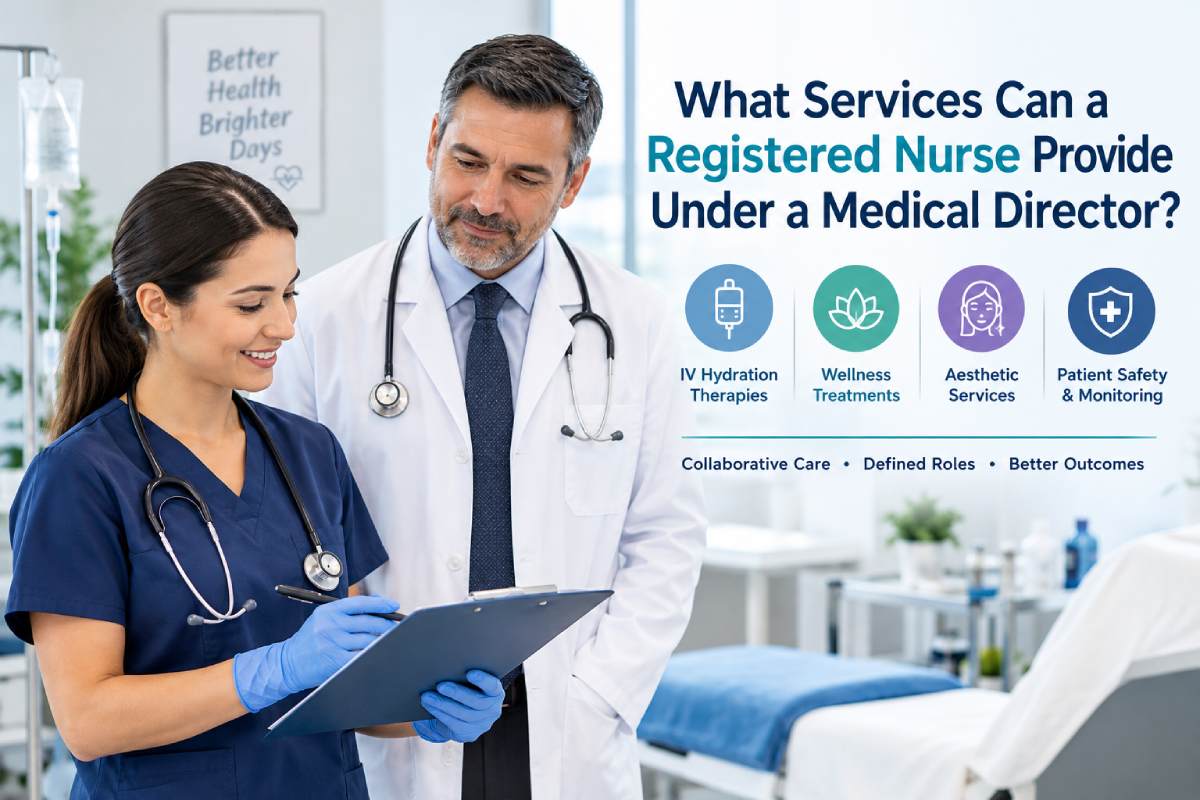
Registered nurses can participate in many healthcare services that involve physician oversight, but a medical director does not give an RN unrestricted authority to diagnose, prescribe, or practice medicine. The services an RN may perform depend on the state nursing practice act, permitted medical orders, training, clinical setting, and the procedure itself. For clinics offering IV hydration, wellness treatments, or aesthetic services, the division of responsibilities should be established before patient care begins. medical director for registered nurse arrangements work best when physician responsibilities, authorized nursing activities, and safety procedures are documented rather than assumed. This distinction helps clinic owners plan services while keeping treatment decisions within the authority of appropriately licensed professionals.
Table of Contents
Key Takeaways: RN Services and Physician Oversight
- An RN generally implements authorized care plans, conducts nursing assessments, administers permitted treatments, and monitors patients within the state-defined nursing scope.
- Physician oversight does not automatically authorize independent medical diagnosis, prescribing, or procedures prohibited for RNs.
- IV hydration, injectable aesthetic treatments, and medication-based wellness services require careful review of state rules and applicable orders.
- Written protocols should identify who evaluates patients, authorizes treatment, addresses complications, and documents care.
- Licensing, competency, supervision, and delegation requirements vary by state, procedure, and staffing model.
What Can an RN Do Under a Medical Director? Start With Nursing Scope
A medical director for registered nurse operations may support services that are already within the RN’s legal nursing scope and are properly ordered or authorized. Typical RN activities include obtaining health histories, performing nursing assessments, measuring vital signs, educating patients, administering medications when authorized, monitoring responses, and documenting care. Which activities can be performed independently as nursing functions and which require an order depends on state law and the circumstances of care.
A nursing assessment is not the same as an independent medical diagnosis. RNs use clinical observations to identify nursing needs, report findings, and follow authorized care plans. Decisions about diagnosing a medical condition, prescribing a drug, or deciding whether a patient qualifies for a medical treatment may be reserved to a physician or another licensed prescribing professional.
Clinic operators should first inventory every proposed service. For each item, identify the person who makes the medical decision, the person who performs the procedure, the required order or protocol, and the escalation process if a problem occurs. A medical director agreement should describe actual duties rather than treat physician affiliation as permission for all proposed services.
Which Nursing Duties Typically Fit Within an RN’s Role?
Registered nurse services commonly involve direct patient care and clinical monitoring, although the details differ by jurisdiction and workplace. An RN may gather patient histories, assess symptoms for nursing purposes, provide patient education, prepare and administer authorized medications, perform certain wound-care activities, and assess a patient’s response to treatment. Competence in a task must be supported by education, training, and applicable employer policies.
In a wellness clinic, an RN might record baseline blood pressure, review reported symptoms, confirm that a valid treatment order is present, begin a permitted infusion, monitor for an adverse response, and record the outcome. That workflow does not make the RN the independent prescriber of the infusion or the person authorized to diagnose why the patient is unwell.
When a planned service includes a new device, unusual medication, invasive procedure, or an off-site physician, clinic owners should confirm the governing rules before adding it to the menu. An employer’s protocol cannot supersede a state nursing practice act.
Can Registered Nurses Administer IV Hydration and Vitamin Infusions?
IV hydration services may be performed by appropriately trained RNs when state rules permit the activity and all required patient evaluations, medication orders, and supervision arrangements are in place. An RN’s technical ability to place an IV does not by itself authorize the RN to choose an infusion formula, decide its medical indication, or prescribe additives. Those medical decisions require authority that the RN license may not provide.
Before an infusion, the clinic should determine who is legally responsible for screening the patient, identifying contraindications, issuing a valid order, and approving any changes to the treatment plan. Nursing responsibilities may include confirming the order, checking allergies, maintaining aseptic technique, monitoring the patient, and responding under established emergency procedures.
Elective IV hydration businesses require special care because rules may address where a physician must be involved, who may assess patients, and what must happen if a reaction develops. A general standing protocol is not always an acceptable replacement for an individualized medical assessment or order. The clinic’s legal and clinical policies should reflect the actual state and treatment setting.
What Safeguards Should Be in Place Before an RN Starts an Infusion?
An RN providing IV therapy should have a defined process for confirming treatment authorization and identifying patient risks. Screening may cover relevant medical conditions, current medications, allergies, prior infusion reactions, hydration status, and vital signs. The appropriate depth of screening is a medical and regulatory decision tied to the particular treatment.
The clinic also needs accessible emergency supplies, role assignments for urgent events, and instructions for escalating symptoms such as shortness of breath, severe discomfort, fainting, or suspected allergic reactions. Staff competency should address both routine infusion care and recognition of complications.
Documentation should show the authorized treatment, what was administered, monitoring findings, any patient response, and follow-up instructions. A medical director can help review the clinical workflow, but the presence of that director does not remove the RN’s own duty to practice within nursing standards.
Are Botox, Fillers, and Other Aesthetic Injections Allowed for RNs?
Aesthetic injections are not automatically within every registered nurse’s permitted practice merely because a medical director is named on the clinic’s paperwork. State laws and nursing-board interpretations determine which procedures an RN may perform, the qualifications required, and who must assess the patient or issue treatment orders. The legal rules can differ for botulinum toxin, dermal fillers, laser treatments, and other cosmetic procedures.
In some jurisdictions, an appropriately trained RN may administer certain ordered injectable treatments under an authorized plan and required physician involvement. In others, the procedure or circumstances may call for a different license, direct supervision, or additional restrictions. Training certificates alone cannot expand statutory scope.
An aesthetic clinic should establish who evaluates treatment suitability, obtains medical informed consent where required, determines injection sites and dosage within the applicable legal framework, and manages complications. Patient safety policies also need to cover emergency referrals and access to medical decision-makers when time-sensitive complications are possible.
What Is the Difference Between Administering a Treatment and Prescribing It?
A registered nurse may be authorized to administer a medical treatment without being authorized to prescribe that treatment. Prescribing concerns the professional decision to select a drug, dose, route, schedule, or treatment for a patient, while administration involves giving a treatment pursuant to a legally valid order and within professional scope.
For example, an RN permitted to administer an ordered injection should not assume that the same permission allows the RN to independently select a prescription product, alter its dosage for a new patient, or diagnose a contraindicating condition. Those functions can fall under medical practice or advanced practice authority, depending on state law.
Medical director policies should distinguish clinical assessment, prescribing, administration, post-treatment monitoring, and patient follow-up. This protects against a common staffing error: using “physician-supervised” as a substitute for identifying the authority required for each decision.
Can an RN Offer Weight Loss, Wellness, and Medication Services?
Registered nurses can support medication-based wellness and weight-management programs through patient education, nursing assessments, authorized medication administration, symptom monitoring, and follow-up coordination. Their role does not ordinarily include independent prescribing or diagnosing medical conditions under an RN license. Practices should distinguish RN duties from those performed by physicians and other professionals who have advanced practice or prescriptive authority.
In a weight-management practice, the prescriber may determine eligibility, select medication, adjust the medical treatment plan, and order relevant testing. An RN may carry out authorized parts of that plan, teach injection technique, review adherence, monitor tolerability, and alert the prescriber when concerning symptoms arise. Local laws and the particular medication may impose further requirements.
Services such as hormone therapy, prescription weight-loss injections, and medically oriented wellness treatments warrant additional review because prescribing rules, drug handling, and appropriate patient evaluation can differ. Marketing a service as wellness does not remove medical-practice restrictions if the service actually involves medical diagnosis or treatment.
How Should RN Follow-Up and Patient Education Be Organized?
An RN’s follow-up role should be linked to an authorized medical treatment plan. The clinic can define what nursing observations to collect, what side effects to discuss, which findings require escalation, and when a patient must be reassessed by a prescribing clinician. This approach gives nurses an actionable workflow without transferring prescribing authority through informal instructions.
Patient education may cover the prescribed regimen, safe medication handling, expected monitoring steps, and signs that require prompt care. An RN should report observations that suggest a new medical problem rather than independently changing a prescription when such changes are outside the RN’s authority.
Written workflows, medication administration records, and appropriate handoff notes make the responsibilities visible to both staff and supervising professionals. Policies should be updated when a new medication or treatment type is introduced.
How Do Medical Directors, RNs, and Delegation Rules Work Together?
Physician oversight and nursing delegation refer to different legal responsibilities. A physician may delegate certain medical tasks when state law authorizes delegation and the relevant supervision conditions are met. Separately, an RN may delegate certain nursing tasks to other personnel under nursing-board rules, but cannot use nursing delegation to transfer a task beyond the delegatee’s lawful role or the RN’s own authority.
The title medical director does not erase those distinctions. Clinic policies should state which professional evaluates patients, orders treatments, performs procedures, monitors care, and handles emergencies. For practices relying on remote physician support, availability and physical-presence rules must be checked for each service and state.
A sound oversight arrangement also includes competency assessment, medical record access consistent with privacy rules, incident reporting, and routine review of patient safety practices. These measures should correspond to legal requirements and clinical needs, not a generic promise of physician supervision.
What Should a Clinic Check Before Adding a New RN-Performed Service?
A medical director for registered nurse clinics should participate in defining the clinical responsibilities that fall within the physician’s role, while the RN remains accountable for complying with nursing standards. Before launch, the clinic should confirm the state licensing rules for every professional involved and the exact service proposed. A service permitted in one state may require different orders or supervision elsewhere.
- Identify whether the proposed task is nursing care, medical diagnosis, prescribing, or a restricted procedure.
- Verify RN training, demonstrated competency, and any applicable certification requirements.
- Document who performs the medical assessment and provides legally required treatment orders.
- Define the level of on-site or remote physician availability required by law and clinical risk.
- Set protocols for consent, documentation, complications, referrals, and quality review.
Clinic owners should also revisit these decisions as services, staffing, or state regulations change. Hiring a medical director can support a clearer clinical structure, but it is not a substitute for procedure-by-procedure legal review.
Conclusion
A registered nurse working with a medical director may provide nursing assessments, authorized IV therapy, permitted injections, medication administration, patient education, and follow-up care, provided each activity fits the state nursing scope and applicable clinical orders. Physician oversight can establish treatment protocols and professional accountability, but it does not give an RN independent authority to diagnose, prescribe, or perform restricted procedures. Matching each service to the right license, order, training, and supervision arrangement creates a safer foundation for clinic operations.
Build an RN Service Plan With the Right Physician Support
Medical Director Co. helps healthcare practices connect with physicians for appropriate clinical oversight arrangements. Review your proposed RN services and request a physician match that aligns with your state and practice model.